Patrick Hughes
-
 Canaluscious, 202523 13/16 x 26 1/4 x 6 1/2 in.
 -
Canaletto, 202417 7/8 x 39 5/8 x 6 1/4 in.
-
Chairs, 202425 5/8’’ x 19 1/4’’ x 7’’
-
Titles, 202422 3/16’’ x 16 1/4’’ x 9 7/8’’
-
Paree, 202315 1/2 x 44 5/16 x 6 7/8 in.
-
Studio, 202317 11/16 x 40 1/8 x 6 11/16 in.
-
Golden, 202218 1/8 x 22 3/4 x 6 11/16 in.
-
Banksi, 202115 1/2 x 44 1/4 x 6 5/8 in.
-
Robotic, 202020’’ x 21’’ x 6 1/4’’
-
Banksee, 201917 1/4 x 40 1/8 x 6 5/8 in.
-
In and Out, 201918 1/4 x 41 1/4 x 7 3/4 in.
-
Maeght, 201817 5/8’’ x 35 3/8’’ x 7’’
-
Palazzi, 201517 3/8 x 38 x 6 1/4 in.






-
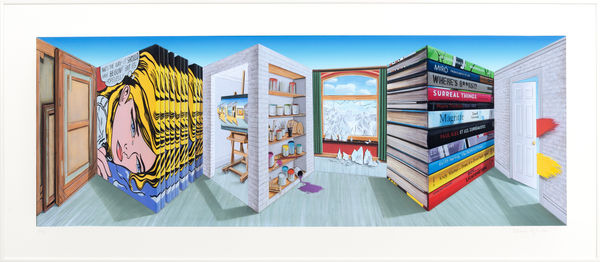
 Golden, 2022
-
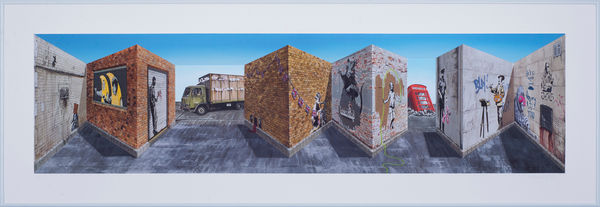
 Banksee, 2019
-
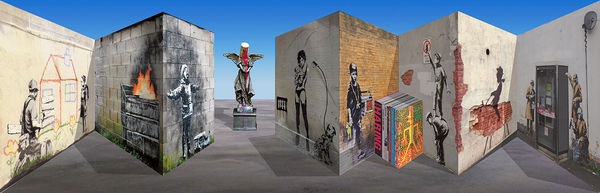
 In and Out, 2019
"He is the creator of "reverspective," an optical illusion on a three-dimensional surface where the parts of the picture which seem farthest away are actually physically the nearest."
A British painter born in 1939 and based in London, Patrick Hughes is the inventor of reverspective, a technique as radical as it is fascinating that turns a three-dimensional surface into an animated illusion of depth. His works appear to move in response to the viewer's position, creating an experience that is at once sensory and philosophical, a meditation on the nature of seeing and perception. A pioneer of the optical illusion in contemporary painting, he has been exhibiting for over fifty years in major cities around the world.
At Galerie de Bellefeuille, we are proud to present a selection of his most sought-after paintings, including works from the iconic Banksee and Palazzi series.
The Icon of Reverspective
The vision of Patrick Hughes rests on an idea that seems at first paradoxical: to paint in reverse perspective logic. In a Patrick Hughes painting, the surfaces that physically protrude the most represent the most distant elements of the scene, while those that recede depict the foreground. The result is a powerful and disorienting optical illusion painting, in which the work appears to shift, deepen and transform the moment the viewer moves their head.
This invention, which he calls reverspective, is not merely a visual trick. It questions how we construct our gaze, how reliable our perception is, and how the brain interprets space. Trained in Birmingham and active since the 1960s, the artist initially moved alongside the British Surrealist movement before carving his own path. His earliest explorations of reverse perspective date to 1964, with Sticking Out Room, a life-size installation presented at the ICA in London in 1970. It was not until 1990 that he returned to reverspective to develop its full potential.
Signature Series: Urban Reverspective
The most emblematic Patrick Hughes paintings draw on architectural and urban settings: Venetian façades (Palazzi, Canaletto), Parisian streets (Paree) and imagined cityscapes (Sea City). These familiar panoramas become the ideal terrain for reverspective: the viewer's eye recognizes a realistic scene, but their sense of space is immediately confounded by the apparent movement.
The technique is as demanding as the result is immediate. Each work is built on a carved wooden relief support, whose planes are painted in reverse trompe-l'œil. The accumulation of detail, chromatic precision and mastery of light complete the illusion: the Patrick Hughes artwork breathes, undulates and opens onto an impossible depth.
The Banksee Series
With Banksee (2019), Patrick Hughes stages a playful dialogue with street art and contemporary culture. By incorporating Banksy's imagery into his reverspective grammar, he brings together two subversive forms of visual disruption: one through stencil and the street, the other through geometry and illusion. The result is both witty and intellectually stimulating.
This series demonstrates the artist's ability to constantly renew his vocabulary while remaining true to his founding principle. Reverspective is not a fixed technique but a tool for thinking, adaptable to any subject, whether an art gallery (Studio), a row of chairs (Chairs) or book covers (Titles).
Collecting Patrick Hughes
To acquire a Patrick Hughes painting is to own a living work, a piece that changes with every glance and engages the body as much as the mind. His paintings are held in numerous private and institutional collections around the world, from London to New York, Seoul and Toronto. A Hughes work does not decorate a wall: it transforms it.
Collectors drawn to art that plays with perception will find a complementary universe among other artists at the gallery: Julian Opie's optical paintings, Carlos Cruz-Diez's kinetic paintings and Victor Vasarely's optical art. To discover Patrick Hughes art for sale and explore the works currently available, our team welcomes you to our spaces in Montreal and Toronto.
Career Highlights
-
Born in 1939 in Birmingham, Patrick Hughes invented reverspective as early as 1964 with Sticking Out Room, presented at the ICA in London in 1970.
-
He returned to reverspective in 1990, developing it into a coherent and immediately recognizable pictorial language.
-
His Patrick Hughes artwork has been exhibited in London, New York, Santa Monica, Seoul, Chicago, Munich and Toronto.
-
A painter, author and theorist, he has published several books on humour, paradox and visual perception.
Notable Exhibitions
-
Institute of Contemporary Arts (ICA), London, from 1970.
-
Solo exhibitions in London, New York, Chicago, Santa Monica, Seoul, Munich and Toronto.
-
Regular presentations at Galerie de Bellefeuille, Montreal and Toronto.