Jim Dine
-
Works
-
 The Heart Called Washington, 201431 x 25 1/2 in.
 -
The Tide of Debt, 201478 3/4 x 51 3/16 in.
-
Zein Robe, 201454 9/64 x 37 in.
-
Robe with Wasp Nest, 201335 x 27 in.
-
Dark Blue Cloud, 201055 x 28 1/4 in.
-
July on the Palouse, 200770 1/2 x 48 in.
-
The Henry Street Robes, 200517 3/4 x 25 3/8 in.
-
A Beautiful Heart, 199623 1/2 x 19 1/4 in.
-
Ex Voto, 199640 x 53 1/4 in.
-
Owl in the Kitchen, 199635 1/2 x 27 3/4 in.
-
9 Studies for Winter Dream (Ape), 199413 x 10 in.
-
9 Studies for Winter Dream (Cat), 199413 x 10 in.
-
9 Studies for Winter Dream (Crow), 199413 x 10 in.
-
9 Studies for Winter Dream (Heart), 199413 x 10 in.
-
9 Studies for Winter Dream (Mask), 199413 x 10 in.
-
9 Studies for Winter Dream (Owl), 199413 x 10 in.
-
9 Studies for Winter Dream (Self-Portrait), 199413 x 10 in.
-
Behind the Thicket, 199319 3/4 x 27 in.
-
The Colorful Wall, 199345 x 37 1/2 in.
-
Fourteen Color Woodcut Bathrobe, 198277 3/8 x 42 in.
-
The Pink Bathrobe41 1/2 x 29 1/2 in.
-
-
Sculptures
-
Bouquet, 1987
54 x 27 x 25 in., Ed. 6
-
Five Colorful Dancers, One Bronze Heart, 2009
39 x 63 x 29 in., Ed. 6
-
Large Parrot Screams Color, 2007
144 x 82 x 65 in., Ed. 6
-
Model for the Boräs Monument, 2008
25 3/4 x 22 x 13 3/4 in., Ed. 6
-
-
Overview
-
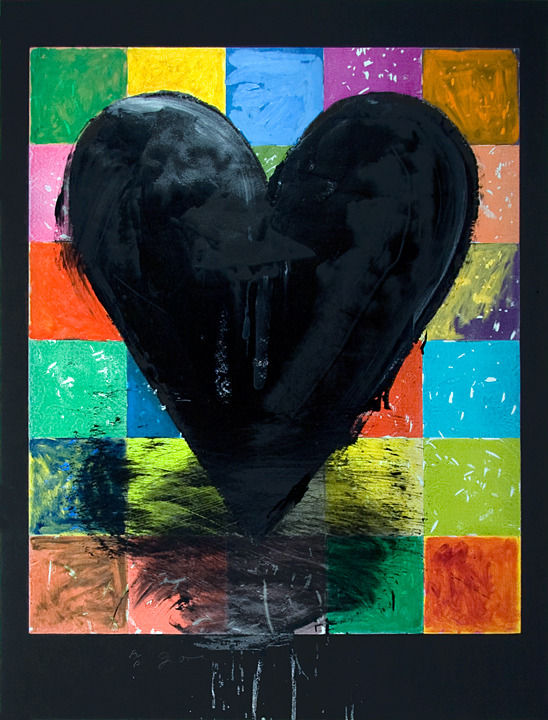
 The Heart Called Washington, 2014
-
 The Colorful Wall, 1993
-
 Two Florida Bathrobes, 1986
"In the pieces that best characterize his work, we also witness the game between the real object and the painted object, a game of trompe-l'oeil. According to him, the canvas is the last “point of contact to unreality” while the object, a symbol of life, remains mostly a concrete object."
A Major Voice in Post-War American Art
Born in Cincinnati in 1935, Jim Dine is one of the most significant American artists of the post-war era. His work spans vibrant large-scale paintings, richly rendered drawings, prints, and bronze sculptures. Closely associated with the Pop Art movement, artist Jim Dine occupies a singular position: he absorbed the energy of his time while consistently resisting its more mechanical tendencies, keeping the personal, the tactile, and the emotional at the center of his practice.
At Galerie de Bellefeuille, we are proud to offer a curated selection of Jim Dine's works to collectors in Montreal, Toronto, and beyond.
From Happenings to Painting: A Practice Defined by Reinvention
Dine's career began in New York in the late 1950s, where he responded to the dominance of Abstract Expressionism not by rejecting it but by expanding it. Alongside contemporaries like Claes Oldenburg, he organized Happenings: immersive, improvised theatrical events that introduced performance and everyday life into the field of visual art. These early experiments established the two qualities that would define everything he made afterward: a restless formal curiosity and a deep commitment to lived human experience.
When Dine turned to painting, he brought those same instincts with him. His canvases combine painting, collage, assemblage, and the integration of real objects, creating works that blur the line between representation and reality. As he put it himself, the canvas becomes the last point of contact to unreality, while the object, a symbol of life, remains stubbornly concrete.
The Heart: An Icon Revisited Endlessly
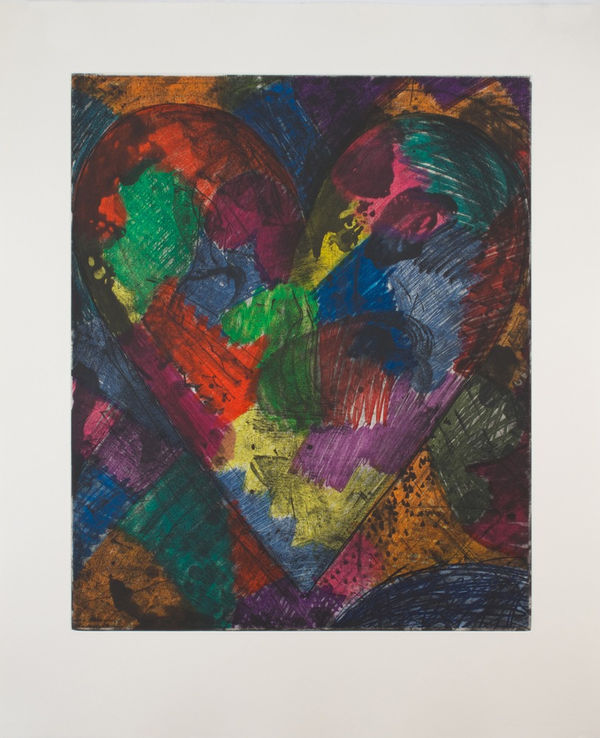
No motif is more closely associated with Jim Dine's art than the Heart. First appearing in his work in the 1960s, the Heart has become one of the most recognizable symbols in contemporary art history, revisited across decades, media, and scales.
But to read the Heart as a sentimental gesture is to misread it. In Dine's hands, it functions as a formal structure: a stable, universally legible shape that allows him to push as far as he wants into color, texture, and paint-handling. Often executed with blurred, melted outlines and chromatic intensity, these works carry the weight of obsession rather than decoration. Jim Dine Hearts remain among the most sought-after works by collectors worldwide, including Two Florida Bathrobe and The Colorful Wall, both available at Galerie de Bellefeuille.
Skulls, Still Lifes, and the Presence of the Everyday
Alongside the Heart, Dine's work returns repeatedly to the skull, the bathrobe, tools, and other objects drawn from daily life. These recurring motifs connect his practice to the tradition of still life painting while charging that tradition with psychological weight. The skull in particular operates as a contemporary memento mori: a reminder of mortality placed deliberately in the midst of ordinary things, asking the viewer to hold beauty and transience at the same time.
This insistence on the handmade and the personal sets Dine apart from the more ironic, detached aesthetics of his Pop Art contemporaries. Where Warhol embraced mechanical reproduction, Dine doubled down on the mark, the gesture, and the evidence of a human hand.
Sculpture and the Natural World
From the 1980s onward, sculpture became an increasingly central part of Dine's practice. His three-dimensional work draws more from nature than from man-made objects: trees, roots, the human body, and particularly the Venus de Milo, which he has returned to across numerous series. Cast in bronze, these sculptures carry the same expressive intensity as his paintings, combining mythological weight with a deeply personal visual language.
The Venus de Milo series in particular has become a signature of his sculptural output, transforming a canonical art-historical image into a vehicle for personal meditation on beauty, fragmentation, and time.
Legacy and Recognition
Jim Dine's career spans more than six decades and encompasses painting, drawing, printmaking, sculpture, poetry, and performance. His works are held in the permanent collections of the Museum of Modern Art (MoMA) in New York, the Tate Modern in London, the Centre Pompidou in Paris, and dozens of major institutions worldwide.
In 2019, he was appointed Chevalier de l'Ordre de la Legion d'honneur by the French Republic, one of the highest distinctions awarded to artists internationally. His continued presence in major collections and art fairs confirms his standing as one of the most enduring figures in post-war and contemporary art.
Collecting Jim Dine
For collectors seeking Jim Dine art for sale, Galerie de Bellefeuille offers authenticated access to paintings, prints, and drawings from across his career. Works from the Heart series are available for viewing and acquisition at our galleries in Montreal and Toronto.
Jim Dine's market is well-established and supported by sustained institutional interest and a deep international collector base. For information on current availability and pricing, contact Galerie de Bellefeuille directly.
Key Facts
-
Born in Cincinnati, Ohio, 1935.
-
Associated with the American Pop Art movement and the Happenings of the late 1950s.
-
Signature motifs: the Heart, the skull, the bathrobe, the Venus de Milo.
-
Works held at MoMA, Tate Modern, Centre Pompidou, and major institutions worldwide.
-
2019: appointed Chevalier de l'Ordre de la Legion d'honneur, France.
-
Represented in Canada by Galerie de Bellefeuille (Montreal and Toronto).
FAQ
Where can I find Jim Dine art for sale in Canada?
Jim Dine art for sale is available through Galerie de Bellefeuille, his authorized representative in Canada, with gallery locations in Montreal and Toronto.
Contact our team to arrange a viewing appointment.How much do Jim Dine Hearts cost?
The price of a Jim Dine Heart painting varies based on format, medium, year of creation, and market demand. His works have appreciated consistently over time and are held in prestigious collections worldwide. For accurate, up-to-date pricing, contact Galerie de Bellefeuille directly for a personalized consultation.
-