Jean-Paul Riopelle
-
 Vol de Chute, 196128 5/8 x 36 1/8 in.
 -
Sans titre, 195931 1/2 x 23 1/2 in.


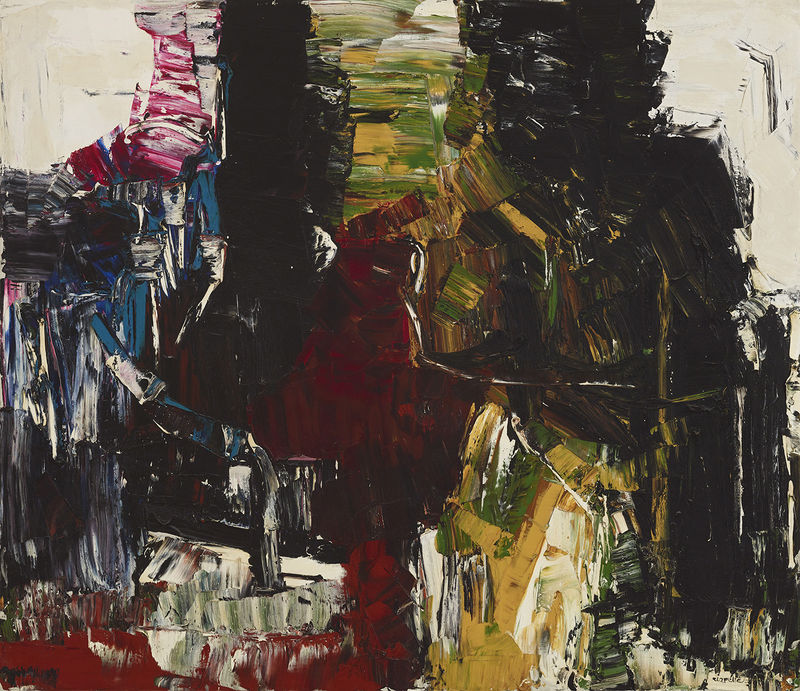
Jean-Paul Riopelle (1923–2002) is the most important Canadian painter of the twentieth century and one of the towering figures of international lyrical abstraction. Born in Montreal, a signatory of the Refus global manifesto in 1948, he settled in Paris in 1947 and established his palette-knife technique at the heart of the global avant-garde. His work, prolific and ever-evolving, spans more than fifty years of creation and represents a cultural heritage of immense significance.
At Galerie de Bellefeuille, we are proud to present a selection of his most sought-after works, including Riopelle paintings from the iconic Sans titre and Vol de Chute series, witnesses to his most accomplished abstract period.
The Icon of Quebec Lyrical Abstraction
The trajectory of Jean-Paul Riopelle is inseparable from two decisive ruptures. The first took place in Montreal, when the young Riopelle painter joined the Automatiste group around Paul-Émile Borduas and co-signed the Refus global in 1948, a founding manifesto that shattered the social and artistic conventions of post-war Quebec. The second unfolded in Paris, where he met André Breton, moved among the Surrealists, and gradually established himself as the only Canadian artist recognized at a European and global scale.
It was in Paris, at the turn of the 1950s, that the style which would define his legend emerged. Abandoning the brush in favour of the palette knife, Riopelle developed his mosaic technique: surfaces entirely covered in dense, structured bursts of colour, laid down in thick layers according to a logic of gesture and matter. This all-over approach, which abolishes any hierarchy within the picture plane, sits at the crossroads of European lyrical abstraction and American abstract expressionism, while remaining deeply original. His first exhibition at the Galerie Pierre Loeb in 1953 marked the beginning of international recognition.
Signature Series: The Palette-Knife Mosaics
The Jean Paul Riopelle paintings of the 1950s and 1960s, including Sans titre (1959) and Vol de Chute (1961), represent the very core of his output. These large-format canvases are built on an accumulation of vigorous chromatic strokes, applied with a palette knife with an energy that evokes both construction and musical improvisation. The surface vibrates, densifies, and generates a paradoxical depth: no conventional perspective, but a material that draws the eye inward.
These mosaics embody the central ambition of Jean-Paul Riopelle: to remain inventive, to constantly renew. Each painting is a field of forces, a controlled improvisation in which colour and matter respond to one another without ever submitting to a preliminary drawing. This radical freedom, rooted in automatiste thought and nourished by the major currents of his time, is what gives the works of this period their lasting power.
L'Hommage à Rosa Luxemburg
In 1992, in the days following the death of Joan Mitchell, his companion of twenty-five years, Riopelle painted a monumental frieze of thirty canvases spanning forty metres: L'Hommage à Rosa Luxemburg. Executed with aerosol paint in his studio on Île-aux-Oies, this testament work weaves together the silhouettes of wild geese, everyday objects and animal motifs in an explosion of colour. It was acquired in 1996 by the Musée national des beaux-arts du Québec.
This frieze is at once the mourning of a love and the reckoning of a life. It marks the culmination of Riopelle's evolution toward symbolic figuration, which had begun in the 1970s with his Owls, Icebergs and Wild Geese series, all inspired by hunting and fishing expeditions in Canada's Far North. L'Hommage is widely considered the artistic testament of one of the greatest painters in Canadian history — Jean-Paul Riopelle's most famous painting.
Collecting Jean-Paul Riopelle
To acquire a work by Jean-Paul Riopelle is to take possession of a fragment of Canadian and international art history. His Jean-Paul Riopelle artwork from the abstract period, particularly those from the years 1955–1965, rank among the most sought-after on the secondary market and are held in the world's greatest institutional collections. The rarity of works available through galleries makes them first-tier acquisitions for any serious collector.
Collectors drawn to this gestural and lyrical painting will find deep resonances among other artists at the gallery: Paul-Émile Borduas's automatist paintings, Riopelle's fellow traveller and co-signatory of the Refus global, Nicolas Ruel's abstract photography, which extends a similar sensitivity to gesture and colour into another medium, and Zhang He's gestural canvases. To learn more about Riopelle art for sale and the works currently available at the gallery, our team welcomes you in Montreal and Toronto.
Career Highlights
-
Born in 1923 in Montreal, Riopelle joined the Automatistes in 1946 and co-signed the Refus global in 1948 alongside Paul-Émile Borduas.
-
Settled in Paris from 1947, he became the only Canadian painter recognized internationally during his lifetime.
-
At the turn of the 1950s, he developed his palette-knife mosaic technique, consecrated by his first Parisian exhibition at Galerie Pierre Loeb in 1953.
-
In 1992, he created L'Hommage à Rosa Luxemburg, a 40-metre frieze acquired by the Musée national des beaux-arts du Québec, widely regarded as his artistic testament.
-
Riopelle passed away in 2002 on Île-aux-Oies, Quebec.
Notable Exhibitions
-
Galerie Pierre Loeb, Paris, 1953: the landmark exhibition that launched his international recognition.
-
Musée national des beaux-arts du Québec (MNBAQ): permanent collection including L'Hommage à Rosa Luxemburg.
-
Retrospectives across Canada and France throughout the 1980s and 1990s.
-
Fondation Jean Paul Riopelle, Montreal: the institution dedicated to preserving and promoting his life's work.